



Invisalign vs veneers is one of the most common questions patients ask when they decide they want to improve their smile — and it is almost always the wrong starting question. Not because the comparison isn’t useful, but because “which gives better results” depends entirely on what result you are trying to achieve. These two treatments solve different problems. Choosing between them without understanding that distinction leads to patients pursuing a treatment that isn’t matched to their actual situation.
The answer is not that one is better. The answer is that one is right for you — and identifying which one requires understanding exactly what each treatment does, what it cannot do, and where the goals you have for your smile fit into that picture.
Here is the complete, honest comparison.
What Each Treatment Actually Does
This distinction is the foundation of the entire decision.
Invisalign is an orthodontic treatment. It moves teeth. Using a series of custom-made clear aligners worn 20 to 22 hours a day, Invisalign gradually repositions teeth over a period of six to eighteen months, correcting crowding, spacing, rotations, and bite issues. At the end of treatment, the teeth are in different positions than they were at the start. The underlying tooth structure is untouched. The treatment is, in clinical terms, reversible — though a retainer must be worn indefinitely to maintain the result.
Veneers are a restorative and aesthetic treatment. They do not move teeth. A veneer is a thin shell of porcelain or composite material bonded to the front surface of a tooth, changing its colour, shape, length, or texture. Multiple veneers — typically six to ten across the upper front teeth — can transform a smile’s appearance dramatically and quickly. They cannot change the position of teeth in the jaw. To place veneers, a small amount of enamel is removed from the tooth surface to make room for the restoration. This preparation is permanent — once enamel is removed, the tooth will always require a veneer or crown to protect it.
The core distinction is this: Invisalign changes where your teeth are. Veneers change how your teeth look. Those are different objectives, and they call for different solutions.
When Invisalign Is the Right Choice
Invisalign is the correct treatment when the primary concern is tooth position. If your teeth are crowded, spaced, rotated, or your bite is misaligned — and the underlying tooth structure is otherwise healthy and a reasonable colour — orthodontic treatment addresses the actual problem rather than masking it.
Invisalign has a documented success rate of 80% to 90% for mild to moderate alignment cases. For complex malocclusion — significant overbites, underbites, severe crowding — traditional fixed appliances may be more appropriate, and an orthodontic assessment will clarify which cases fall within Invisalign’s scope.
The practical advantages of Invisalign are well established. The aligners are nearly invisible in day-to-day wear, removable for eating and oral hygiene, and produce no dietary restrictions. Treatment completion typically takes six to eighteen months depending on case complexity, followed by indefinite retainer wear to maintain alignment. The American Dental Association notes that Invisalign results, when maintained with a retainer, are stable over the long term.
Invisalign is also the tooth-preserving choice. No enamel is removed. The natural tooth structure is maintained throughout treatment and beyond. For younger patients in particular, this has significant long-term implications: a tooth with intact enamel will serve the patient for decades with normal maintenance, whereas a tooth prepared for a veneer is permanently altered.
The limitation of Invisalign in the context of a smile transformation is that it only addresses position. It does not whiten teeth, close chips, alter tooth shape, or change the proportions of the smile beyond what repositioning achieves. Patients who complete Invisalign and then want to address colour or minor shape concerns typically combine the orthodontic treatment with teeth whitening — a simple, non-invasive addition that can be completed after alignment is stable.
When Veneers Are the Right Choice
Dental veneers are the correct treatment when the goal is aesthetic transformation of the visible teeth — and particularly when colour, shape, proportion, or texture are the primary concerns rather than position.
Veneers correct things Invisalign cannot touch: intrinsic tooth discolouration that doesn’t respond to whitening (fluorosis, tetracycline staining, or discolouration from root canal treatment), worn or chipped tooth edges, teeth that are too small or poorly proportioned for the face, and minor surface imperfections like cracks and texture irregularities.
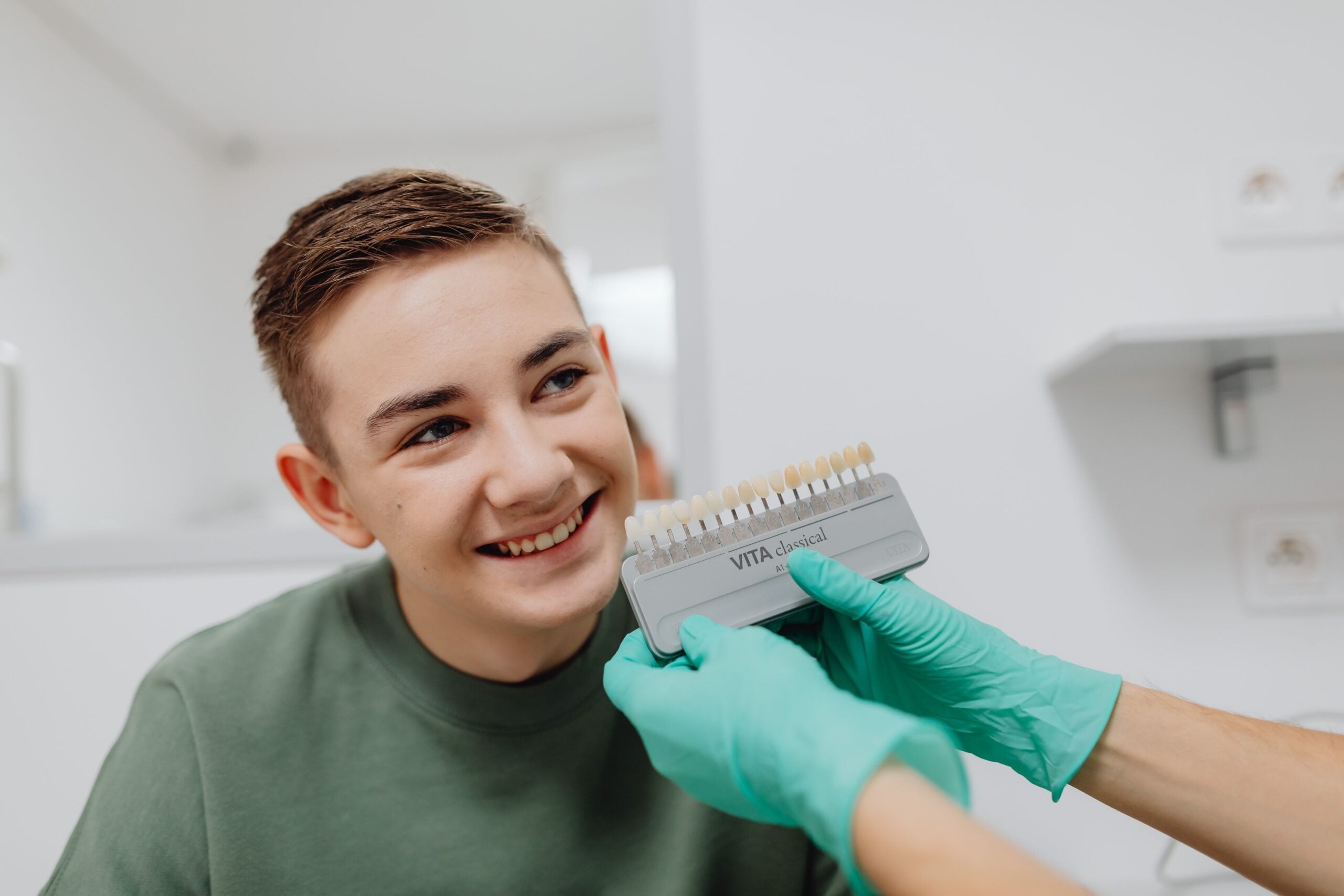
For patients pursuing a Hollywood Smile — a complete aesthetic transformation of the front teeth to achieve a bright, even, symmetrical result — veneers are the primary tool. A skilled cosmetic dentist uses digital smile design to plan the shape, proportion, and colour of the veneers before any preparation takes place, allowing the patient to preview the intended result and confirm it matches their expectations.
The timeline advantage of veneers is significant. The entire process from consultation to finished result typically requires two to three appointments over two to four weeks. For patients with a specific deadline — a wedding, a reunion, an important event — veneers deliver a transformation on a timeline that orthodontic treatment cannot match.
Porcelain veneers last ten to twenty years with proper care. Composite veneers last five to seven years and require replacement at lower cost. Both options require the commitment of enamel preparation — once the tooth has been prepared, it needs a restoration permanently. Patients need to understand and accept that permanence before proceeding.
Veneers also cannot correct significant misalignment. Placing veneers on crowded or rotated teeth can create the cosmetic illusion of a more even smile, but it does not address the underlying position and in some cases requires aggressive preparation to accommodate the veneer on a tooth that is not ideally placed. Experienced cosmetic dentists will recommend orthodontic pre-treatment for patients whose alignment is beyond a minor cosmetic concern, precisely to minimise the preparation needed and protect the underlying tooth structure.
The Invisalign vs Veneers Cost Comparison in Albania
In Western Europe and the UK, both treatments represent significant financial commitments. Invisalign typically costs £3,000 to £6,000 in the UK depending on case complexity. A full set of porcelain veneers — ten teeth — runs £8,000 to £15,000 or more.
Patients seeking either treatment in Albania benefit from the same cost differential that applies across all dental procedures. Invisalign treatment at Evo Dental Clinic is available at a fraction of Western European pricing, using the same Align Technology system with the same digital planning tools and the same series of custom-manufactured aligners. Porcelain and composite veneers are similarly priced significantly below UK and Italian equivalents, using the same ceramic materials and fabrication methods.
For patients considering dental tourism in Albania specifically to access either of these treatments, the saving across a full course of Invisalign or a complete veneer case can be substantial enough to more than cover the cost of travel and accommodation. Our dental tourism page covers how treatment visits are structured for international patients in practice.
Can You Combine Invisalign and Veneers?
Yes — and for certain patients, the combination produces results that neither treatment alone can achieve.
The sequence matters. Invisalign is always completed first, because it establishes the final position of the teeth that the veneers will be placed on. Placing veneers before completing orthodontic treatment risks misalignment of the finished restorations as teeth continue to move, or requires removing and replacing veneers after treatment ends.
The combination is most appropriate for patients who have both alignment concerns and aesthetic goals that go beyond what repositioning alone delivers. A patient with mildly crowded teeth and significant intrinsic discolouration, or worn tooth edges combined with spacing, might achieve their ideal outcome through Invisalign followed by a conservative number of veneers to address the remaining cosmetic concerns.
This sequenced approach also allows the minimum number of veneers to be placed on well-positioned teeth, which typically means less preparation per tooth and better long-term outcomes. It is the approach that most closely aligns with the principle of treating conservatively and preserving natural tooth structure wherever possible.
Invisalign vs Veneers: A Clear Summary
The question isn’t which treatment gives better results overall — it’s which treatment matches your specific situation.
Choose Invisalign if your teeth are healthy in structure and colour but in the wrong position. Your goal is to move teeth, you are willing to commit to twelve-plus months of aligner wear, and you want a solution that preserves your natural enamel entirely.
Choose veneers if your teeth are reasonably well aligned but you want to change their colour, shape, proportion, or texture. You want results in weeks rather than months, you are comfortable with a permanent commitment to the restoration, and aesthetic transformation is the primary objective.
Consider both in sequence if you have meaningful alignment concerns alongside cosmetic goals that repositioning alone won’t fully address.
The most reliable way to navigate the Invisalign vs veneers decision is with a proper clinical assessment from a dentist experienced in both treatments — someone who can look at your specific starting point and recommend the path that genuinely serves your goals rather than the one that is simplest to provide.
At Evo Dental Clinic in Tirana, we offer both Invisalign and the complete range of veneer options — faseta porcelani, composite veneers, dhe full smile design — as well as combined treatment planning for patients who benefit from both. If you are working through this decision and want a clinical assessment rather than a generic recommendation, contact us for a free consultation. Share your photos and describe your goals, and we will give you an honest, specific answer about which path makes sense for your smile.
You can also browse our galeria para dhe pas to see results from both treatments and get a realistic picture of what each approach delivers.
Evo Dental Clinic — aesthetic dentistry, Invisalign, and smile design in Tirana, Albania. Serving international patients from across Europe with transparent care and documented results.