


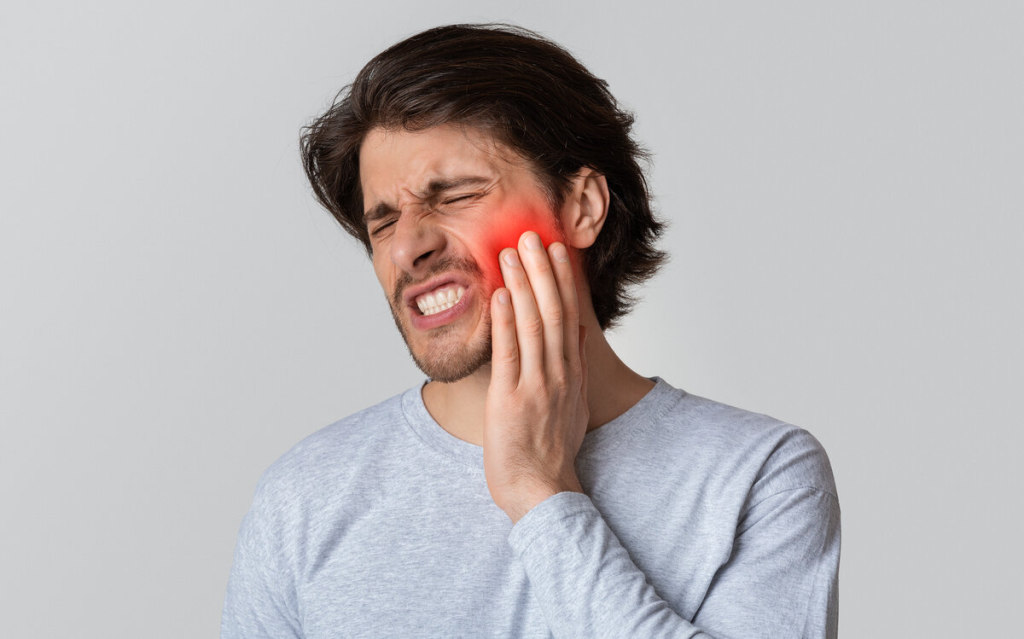
Tooth pain at night has a way of being worse than anything you felt during the day. You managed through work, got through dinner, told yourself it was nothing — and then you lay down and the pain shifted into a different register entirely.
This is not your imagination. There are specific, well-documented reasons why tooth pain at night intensifies after you lie down. Understanding them matters, because they also tell you how serious the underlying problem is and how urgently it needs attention.
Here are the six main reasons tooth pain at night gets worse — and what each one signals about what is happening in your mouth.
1. LYING DOWN INCREASES BLOOD PRESSURE TO YOUR HEAD
The most immediate reason this pain gets worse at night is positional. When you are upright during the day, gravity keeps blood pressure relatively lower in your head and jaw. When you lie down, blood flow to your head increases and pressure distributes differently.
For a tooth with an inflamed nerve or an active infection, that increased blood pressure amplifies the sensation of pain. The nerve is already irritated — the pressure surge makes it fire more intensely.
This is why tooth pain at night often throbs in sync with your heartbeat. The pulsing you feel is your blood pressure directly amplifying the nerve signal. If you notice that sitting upright or propping your head on extra pillows reduces the intensity, this mechanism is almost certainly involved.
2. THERE ARE NO DISTRACTIONS
Pain perception is not purely physiological. The brain actively modulates how much pain it registers depending on how much other sensory information it is processing.
During the day, your brain is busy — screens, conversations, movement, tasks. That cognitive load does not eliminate tooth pain, but it competes with it. The pain signal has to share bandwidth.
At night, that competition disappears. Silence, darkness, no tasks. The brain has nothing else to process, so the pain gets its full and undivided attention. The same nerve signal that felt manageable at 2pm becomes the source of unbearable tooth pain at night by 2am.
This is not weakness or anxiety. It is a documented feature of how the central nervous system processes pain under low sensory input conditions. Knowing this, do not judge the severity of the pain solely by how it feels at its worst hour — but also not to dismiss it because it felt tolerable earlier.
3. BRUXISM — GRINDING YOUR TEETH DURING SLEEP
Many people grind or clench their teeth during sleep without knowing it. Bruxism affects an estimated 8–10% of adults, and the forces involved are significant: sleep grinding can exert up to 250 pounds of pressure per square inch — far more than the jaw produces during normal chewing.
If you already have a compromised tooth — a hairline crack, a worn filling, early decay, or an inflamed nerve — that repeated pressure during sleep can push the pain threshold dramatically. Pain that seems to peak in the early morning hours, or that comes with jaw soreness, headaches on waking, or worn tooth surfaces, often has a bruxism component.
A night guard distributes bite forces and protects vulnerable teeth. But the underlying cause of the grinding — stress, bite misalignment, airway issues — needs assessment too.
4. TEMPERATURE SENSITIVITY IS MORE NOTICEABLE AT NIGHT
During the day, you eat, drink, and move — all of which involve temperature changes in the mouth that can either trigger or momentarily mask tooth sensitivity. At night, the mouth settles into a consistent temperature. If there is a tooth with exposed dentine, a cracked enamel surface, or a receding gum line, that stability can paradoxically make the nerve more sensitive to minor fluctuations — including simply breathing through your mouth.
Cold air drawn in through the mouth during sleep hits exposed nerve endings more directly than at any other point in the day. For patients with dentine hypersensitivity, nighttime tooth pain triggered by breathing — a sensation they may not associate with dental sensitivity at all — is the result of exactly this mechanism.
5. DENTAL ABSCESSES FOLLOW THEIR OWN RHYTHM
A dental abscess — a bacterial infection at the root of a tooth or in the gum tissue — does not pause at night. If anything, the body’s inflammatory response follows circadian patterns, with certain inflammatory markers and immune activity peaking in the late evening and early morning hours.
Abscesses also accumulate pressure. The pus and bacterial activity inside an abscess cavity generates pressure that has nowhere to go. When you lie down and blood pressure in the head increases, that pressure builds further. The result is pain that can reach a level that makes sleep genuinely impossible.
An abscess is the most urgent dental situation on this list. It does not resolve without treatment. Left untreated, the infection can spread to the jaw, neck, and — in severe cases — the airway. If the pain is accompanied by swelling, fever, a bad taste in the mouth, or visible swelling in the jaw or cheek, you need dental treatment promptly — not in a few days.
6. SINUS PRESSURE THAT CAUSES TOOTH PAIN AT NIGHT
Not all nighttime tooth pain originates in the teeth. The upper back teeth — the upper molars and premolars — sit directly beneath the maxillary sinuses. When sinus pressure increases, which it often does when you lie down and drainage slows, the pressure is transmitted directly to the nerve roots of those teeth.
The result is a deep, diffuse aching in the upper back teeth that genuinely feels like tooth pain but has no dental origin. It typically affects multiple teeth rather than a single isolated tooth, tends to be worse on both sides or directly below the affected sinus, and may come with other sinus symptoms — pressure behind the cheeks, congestion, or post-nasal drip.
This distinction matters for treatment. Sinus-related pain resolves when the sinus issue is treated. Dental treatment will not help it.
WHAT TO DO ABOUT TOOTH PAIN AT NIGHT
Immediate relief while waiting for treatment
- Sleep with your head elevated. Extra pillows or a wedge pillow reduces blood pressure to the head and can meaningfully reduce throbbing intensity.
- Over-the-counter pain relief. Ibuprofen is generally more effective than paracetamol for dental pain because it has an anti-inflammatory component. Follow dosage instructions.
- Avoid temperature extremes before bed. Very hot or very cold food and drink before sleeping can trigger or intensify sensitivity-related pain overnight.
- Clove oil on the affected area. A small amount applied with a cotton bud provides temporary numbing through eugenol, the active compound. This is a temporary measure, not a treatment.
When to seek urgent care
Severe tooth pain at night — especially when accompanied by swelling, fever, or difficulty swallowing, or that has been worsening over several days requires prompt attention. Do not wait it out in the hope that it resolves.
THE UNDERLYING MESSAGE
Persistent tooth pain at night that intensifies when you lie down, throbs with your heartbeat, or keeps you from sleeping is your body flagging a problem that will not fix itself. The causes range from reversible sensitivity issues to active infections that require urgent intervention.
The right response is not to find the strongest painkiller that gets you through the night — it is to identify the cause and treat it properly.
If you are experiencing persistent or severe tooth pain, Evo Dental Clinic offers consultations for international patients, including remote assessment before you travel. Whether the issue is an abscess requiring root canal treatment, advanced decay, or a tooth that has deteriorated beyond saving and needs replacement with an implant, a clear diagnosis is the first step.