


Most people who need delaying implant surgery to replace a missing tooth don’t make a deliberate decision to wait. They make a series of small, incremental ones. The quote from their dentist at home was higher than they expected. They meant to look into alternatives but didn’t get around to it. The tooth doesn’t hurt. Life got busy. And so the gap stays, and the months turn into a year, and then two.
What those patients rarely understand is that delaying implant surgery is not a neutral holding pattern. The mouth does not pause and wait. Every month without a replacement tooth, a set of biological and structural changes continues to unfold — some slowly, some faster than expected — that make the eventual treatment more complex, more expensive, and in some cases, more limited in its options than it would have been had they acted sooner.
This is what happens when implant surgery is delayed — and why August, when European patients have time and access to affordable, high-quality treatment in Albania, is the moment to stop delaying.
Danger 1: Bone Loss That Begins Within Days of Tooth Loss
The jawbone exists to support teeth. When a tooth is removed, the bone in that area receives no more stimulation through chewing — and without that stimulation, the body begins to resorb it. This process is not hypothetical or slow-building. It begins within days of extraction and is most rapid in the first three to six months.
The numbers are specific. In the first year after tooth loss, patients typically lose up to 25% of the bone width at the extraction site. After the first year, resorption continues at a slower rate of approximately 0.5 to 1% per year — but it never stops. Over several years without replacement, the ridge can resorb to a point where standard implant placement is no longer possible without first rebuilding the lost bone through grafting.
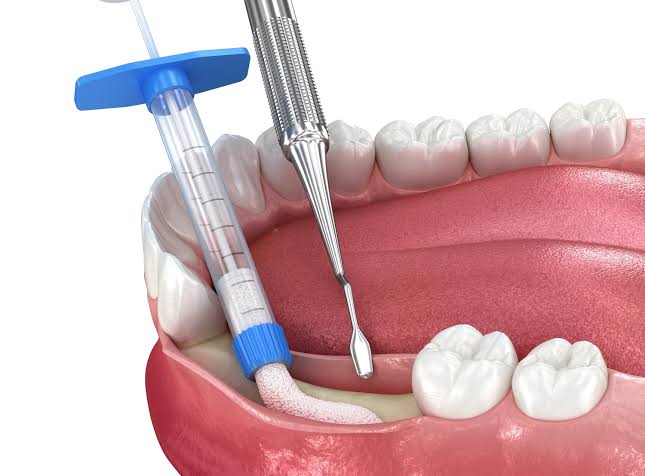
A standard dental implant requires a minimum of 6 mm of bone width and 10 mm of bone height at the placement site. When post-extraction resorption brings the ridge below those thresholds, bone grafting becomes a prerequisite for implant placement rather than an optional enhancement. Delaying implant surgery beyond six months significantly increases the likelihood of needing additional grafting — adding cost, adding healing time, and adding complexity to what could have been a straightforward procedure.
The patients who have the simplest, most predictable implant placement are the ones who acted while their bone was still substantially intact. Each month of delay narrows that window.
Danger 2: Neighbouring Teeth Begin to Drift
A gap in the dental arch is not a stable situation. The teeth adjacent to the gap — and the tooth opposing it in the other jaw — respond to the empty space by gradually migrating toward it. This is not a rapid or dramatic movement, but over months and years it is measurable and clinically significant.
Adjacent teeth tip toward the gap, reducing the space available for an implant and crown and changing the angle at which they erupt from the gum. The tooth opposing the gap — in the upper or lower jaw — may over-erupt downward or upward into the empty space, creating a protrusion that alters the bite relationship across that area of the mouth.
These changes compound each other. A bite that has been altered by tooth drift produces uneven wear on the remaining teeth, increases the load on specific tooth contacts, and can contribute to jaw joint strain and headaches. Correcting a bite that has shifted significantly may require orthodontic treatment before implant placement becomes straightforward — which adds months and cost to the treatment timeline.
Acting before significant drift occurs keeps the implant placement simple. The space is the right size, the adjacent teeth are in the right position, and the crown can be fabricated to ideal proportions without accommodating the consequences of prolonged absence.
Danger 3: Gum Tissue Changes That Complicate the Aesthetic Result
The gum tissue around a gap also changes over time in ways that affect the final aesthetic result of an implant. The papillae — the triangular points of gum tissue that fill the spaces between teeth — gradually recede when they no longer have adjacent tooth structure to support them. The gum contour in the gap area flattens.
When an implant is placed and a crown is fitted after significant time has passed, the crown may emerge from a flat gum line rather than the natural contoured tissue that surrounds healthy teeth. The result can look clinical rather than natural — a perfectly good implant and crown that doesn’t blend as seamlessly with the surrounding teeth as it would have if placed earlier.
Experienced implantologists can manage gum tissue changes through careful technique, and in some cases soft tissue grafting can restore volume that has been lost. But both of these additions — the technique complexity and any supplementary grafting — are consequences of delay that early implant placement avoids entirely.
Danger 4: Increased Risk of Implant Failure
Bone quality and volume are the foundation of successful osseointegration — the process by which the titanium implant post fuses with the jawbone over three to six months after placement. Implants placed in dense, well-preserved bone fuse predictably and reliably. Implants placed in bone that has been compromised by resorption, infection, or reduced density face a more challenging biological environment.
Delaying implant surgery increases the risk of implant failure because implants need stable, healthy bone to bond well. Poor bone quality or reduced bone volume makes implant placement less predictable. Active gum disease, if it develops in the gap area during the delay period, must be treated and fully resolved before an implant can be placed — because placing an implant into an infected environment significantly increases the likelihood that osseointegration will fail.
Every variable that makes implant failure more likely — reduced bone, reduced bone quality, gum infection, systemic conditions exacerbated by poor oral health — is more likely to be present the longer treatment is delayed. Acting sooner, in healthier conditions, produces the most predictable outcome.
Danger 5: The Cost of the Eventual Treatment Keeps Rising
The financial consequences of delaying implant surgery follow a clear trajectory. A straightforward single implant — placed while bone volume is adequate, with no grafting required, in healthy gum tissue — is the lowest-cost version of the treatment. Every complication that delay introduces adds to that baseline.
Bone grafting, when required, adds cost and a healing period of three to six months before implant placement can occur. Soft tissue grafting to restore gum volume adds further cost. Orthodontic treatment to correct tooth drift before implant placement adds months and additional expense. A sinus lift, which may be necessary in the upper back jaw where the sinus expands downward into space vacated by bone resorption, adds a surgical procedure and healing time.
None of these additions are avoidable once the conditions that require them have developed. They are simply the cost of the time that passed. A patient who acts now, before significant bone loss has occurred, avoids all of them. A patient who delays another year may encounter one or several of them — at which point the treatment they could have had at one price becomes a more complex, more expensive, and longer procedure.
This is the financial case that sits beneath the clinical one. Delaying implant surgery to avoid spending money on treatment today is one of the most reliably expensive dental decisions a person can make.
Why August Is the Right Time to Act
August creates an alignment of circumstances that doesn’t exist in the same way at any other time of year.
European patients have time. Summer holidays — whether a week, two weeks, or a longer break — provide the window that implant treatment requires. The first visit, which involves consultation, CBCT imaging, any necessary extractions, surgical placement, and fitting of a temporary crown, takes five to seven days for most patients. Scheduling that visit during August means arriving back at work in September with the implant already placed and osseointegration already underway.
Flights to Tirana are frequent and affordable. Direct connections from London, Milan, Munich, Paris, and Zurich operate daily during the summer season, with journey times of 90 minutes to three hours. The cost of flights and accommodation, set against the saving on implant treatment in Albania compared to the same procedure at home, is typically covered by the price difference on the treatment itself — with money left over.
The bone loss clock is running now. For every patient who lost a tooth three, six, or twelve months ago and has been considering an implant since, the bone that supports the ideal placement outcome has been resorbing throughout that time. August is not a month chosen for marketing purposes. It is a month with available time, available flights, and a cost structure that makes treatment in Albania genuinely accessible — and the simplest possible implant case is the one completed before another season passes.
How Evo Dental Clinic Handles Implant Surgery for International Patients
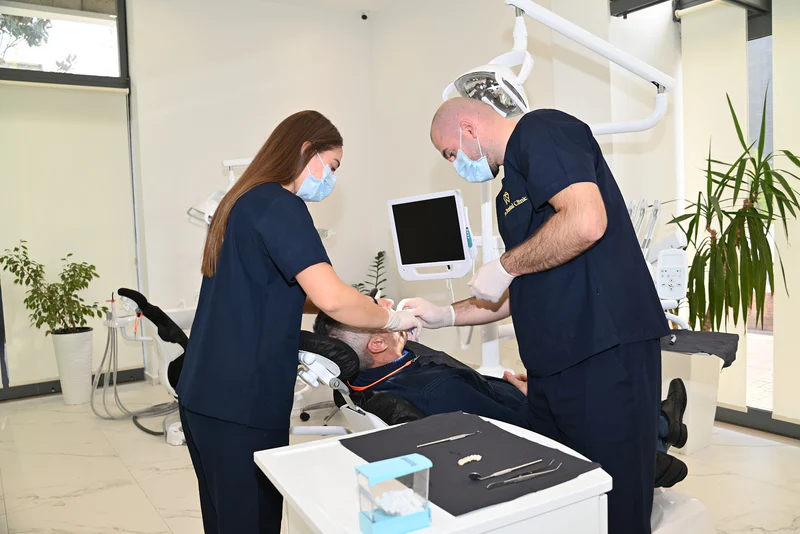
Evo Dental Clinic in Tirana has been placing implante dentare for international patients for 15 years, using Nobel Biocare and Straumann implant systems and CBCT 3D imaging as standard pre-surgical planning tools. Our implantologist assesses bone volume, bone density, and the condition of surrounding teeth and gum tissue before confirming whether immediate placement is appropriate or whether augmentim kockor is needed first.
For patients requiring single implants, the first visit produces a placed implant and a temporary crown — a fixed tooth from day one. For patients needing All-on-4 ose All-on-6 full-arch rehabilitation, the same principle applies: immediate-load fixed teeth on the day of surgery, with the permanent zirconia arch delivered on a return visit three to six months later.
Every patient receives a written treatment plan with documented implant brand, material specifications, and total cost before they travel. We provide a 5-year guarantee on prosthetic components and a lifetime guarantee on implant fixtures, with documented warranty terms and a clear process for international patients. Remote follow-up throughout the osseointegration period keeps our team connected with patients after they return home.
If you have been postponing this decision, the dangers of delaying implant surgery are already accumulating. The best time to act was when the tooth came out. The second best time is now.
Contact us for a free consultation — send your records, describe your situation, and we will provide a written treatment plan and honest assessment of your options before you book anything. You can also browse our galeria para dhe pas and our dental tourism page to understand what the visit involves from start to finish.
August is here. The bone loss is not waiting.
Evo Dental Clinic — dental implants in Albania, placed by internationally trained specialists using certified Nobel Biocare and Straumann systems. Serving patients from the UK, Italy, Germany, and across Europe.